
Let's Stop Pretending School Mental Health Programs Have Anything to do with Mental Health
Harvard child psychiatrist in 2-day celebration of activist "educators making good trouble" pretending to provide mental health services

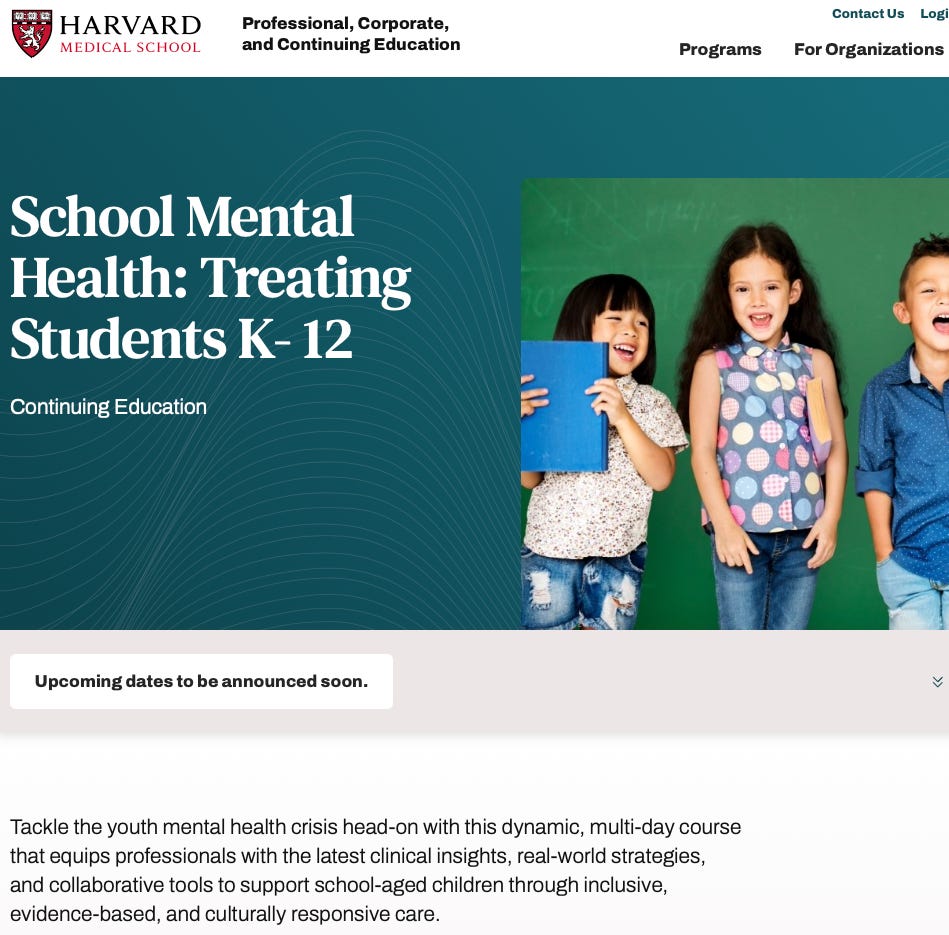
Harvard Medical School associate professor and child psychiatrist Nancy Rappaport has been working in schools for 30 years. And for every year for the past twenty of those years, she holds a Harvard-branded 2-day continuing education conference in Boston for school counselors from around the country.
In a commentary piece published today, Educators keep making ‘good trouble’, Professor Rappaport says this about the $595 per person continuing education course:
“We cover a wide range of topics, from supporting impulsive kids and depressed adolescents, to bullying (or peer aggression), vaping, learning challenges, as well as the larger systemic issues of race, poverty and immigration.”
But this year was so uniquely challenging, so pressure-filled, she worried whether any school counselor could muster sufficient psychic energy to attend at all considering we’re in World War III and suffering plague and famine:
“The pressure on educators has been even more relentless than usual this year, thanks to the decimation of the federal Department of Education, funding struggles in districts everywhere, and the looming possibility of ICE showing up at the school gates. I was apprehensive about whether they would find the energy for two long days of learning.”
So, rather than indulging in unhealthy rumination on the decimation, the struggles, and general anxiety that surely all school counselors must be suffering, the good doctor flipped the script:
She asked the 400 attendees to talk about how they witnessed or participated in making “good trouble“ for their communities - a term she attributes to late Congressman John Lewis denoting “acts of non-violent disobedience to create positive change.”
And here’s what they admitted to doing in the course of performing their publicly-funded job duties instead of actually providing mental health services:
One attendee described how her school purposely worked
to increase stress, anxiety and fear in childrenthrough “reverse evacuation” drills “just in case ICE showed up at school.”Another tells how her school organized surveillance operations during the day where “teachers also volunteered to take turns walking the school block to spot unmarked vans and report to Luce defense hotline” to
increase stress, anxiety and fear in childrenfacilitate the ability of students to (presumably) conceal themselves or flee law enforcement.A school counselor in Maine tells how her school, rather than canceling a community night
to reduce stress, anxiety and fear in children, mobilized the community to offer “rides or walk with school/family volunteers to provide an added level of security.”
These uplifting stories, Professor Rappaport writes, reaffirms her belief that a school mental health program “strengthens communities by nurturing social connections and uplifting mutually supportive healthy relationships.”
“None of us have the illusion of control these days, but there is a sea of humanity who shelters and fortifies our kids — school crossing guards, bus drivers, cafeteria workers, teachers, counselors, school psychologists, administrators, coaches. What I pray for right now, is that we can sustain that army of goodness.“
An Army of Goodness.
Meanwhile, in her home state, spending data shows her local Massachusetts Battalion of Goodness is obviously not cheap, and apparently comes at the cost of academic proficiencies.
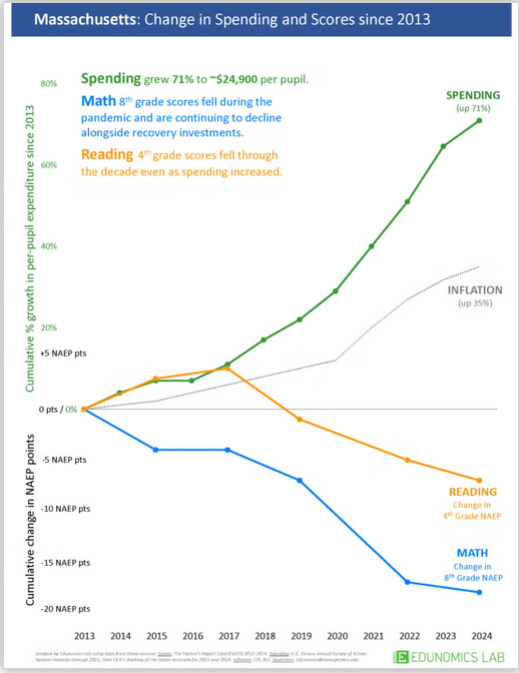
But no matter. For the Harvard child psychiatrist, and many, many of her compatriots in the war against injustice school mental health colleagues, that’s just the price you pay.
End.
[One attendee described how her school purposely worked...through “reverse evacuation” drills “just in case ICE showed up at school.”]
Question: Had ICE ever showed up at any of the 400 participants' schools? Any other schools that they were aware of?